What Would You Do if Someone Took Over Your Stage?
It was one of the lowest (and scariest) moments in my speaking career.
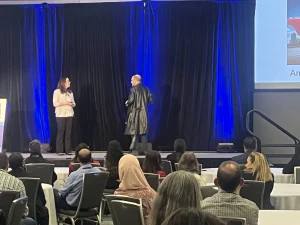
A man unexpectedly came up on the stage during the Q&A period of my presentation.
And I was woefully unprepared.
He had been sitting close to the stage, making comments earlier about the fact that my slides were not both English and French, which he felt was necessary since Canada is a bilingual country.
(To be clear – when I submitted the proposal for my session, we were given the option to deliver in English, French or bilingually. I chose English. I thought that was the end of the story. But apparently it was NOT the end of the story for this guy).
We had hit the last 10 minutes of my presentation, and the conference organizers opened up the Q&A session.
Since there were around 200 people in the room, the instructions were that if someone had a question, they had to walk up to a microphone set up in 2 areas of the room, and ask the question from there.
But when you’re on stage in front of so many people, sometimes the processes fall through the cracks…and you only notice when it’s too late.
He raised his hand, we made eye contact (indicating that he could go ahead), and he stood up, walked right on the stage, and started a fairly aggressive diatribe about how speakers at conferences in bilingual provinces should have slides in both English and French.
I stepped back, and somehow….allowed him to speak. In that moment, I wasn’t quite sure what I was supposed to do.
When I think back now, I have so many regrets:
- I wish I would have stopped him at the stairs, not let him walk onto the stage at all, re-stated the instructions, and redirected him more quickly to the microphones.
- I wish I would not have stepped back when he started speaking.
- I wish that I would have assertively told him to get the heck off my stage.
- I wish that I could have gotten off that stage, after a productive Q&A session, feeling proud and excited over the session that I had just delivered (which, up to this moment, had been going exceptionally well!)
Yes, I also wish that the conference organizers in the room might have done something, but honestly, we were all taken quite by surprise, so I don’t blame them for having the same stunned reaction that I did.
But here’s what I AM glad about (and it’s not even so great, but let’s acknowledge it anyway):
I’m glad that I didn’t fully process the danger of the situation in the moment — and the possible danger of a man wearing a long leather coat in the middle of a hot day in May — which was really quite suspicious.
The processing only came the next day, when I felt a stress and heaviness that I couldn’t quite understand. Until I realized what *could* have happened if he was slightly more….unhinged.
And of course, there were grumpy musings about whether this would have happened to a MALE speaker.
But YES, there’s good news!
As I share with my clients, we have to look at bad presentation experiences and learn from them, to ensure that they don’t ever happen again. These are my takeaways:
- Review the first 3 statements in the “I wish” list above, and if I ever suspect this type of situation in the future, be ready to implement them immediately.
- Call upon the conference organizers for immediate support
- Address the issue in front of the entire audience, to try to limit the incredible awkwardness of what I endured when I tried to get the Q&A back on track after he left the stage.
Generally, to always be fully aware of the surroundings, and be one step ahead. Bummer that it has to be this way, but….if we don’t learn from experience, then what is the experience for?
For what it’s worth, my session became the talk of the conference – although not necessarily for the reasons that I wanted. Is that semi-positive?
➡️ I’d love to hear from you….what would YOU have done if this happened to you?