Speak to Connect, Not to Recite: How to Ditch the Script and STILL Present with Confidence, Authenticity and Connection
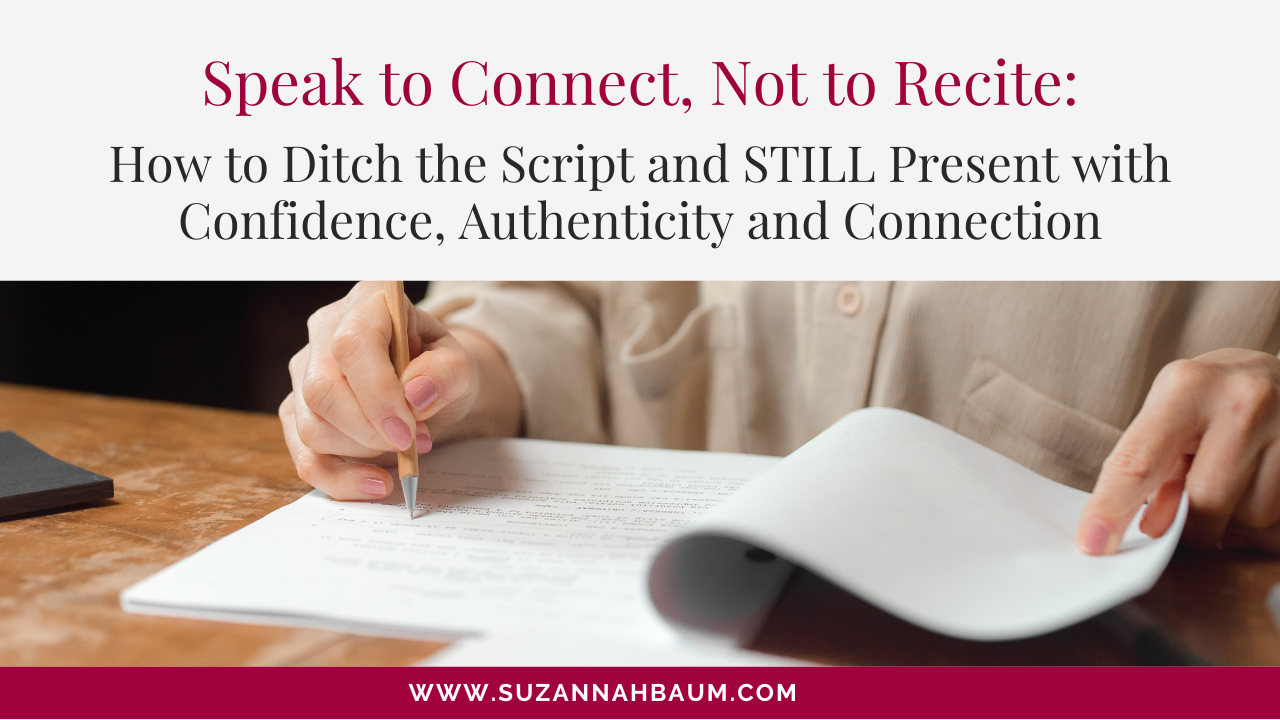
When you are giving a presentation or a prepared speech, do you depend on reading a script so that you can stick to your content, and eliminate the chances of drawing a blank and experiencing the embarrassment of forgetting what you want to say in front of your audience?
There is no doubt that it’s easier and safer when you stick to your script.
You won’t forget important points, you will say everything exactly how you originally intended.
And an added benefit for some people is that you won’t actually have to LOOK at the audience, which ends up reducing some of the nervousness and stress that surrounds public speaking. .
But… when you commit to reading your script, here’s what you ARE missing out on, which could seriously affect the success of your presentation:
1. Minimal eye contact. Since you’re reading your script and therefore not making much eye contact, you could lose out on opportunities to engage and connect with your audience
2. Your voice changes. When reading a script your voice may be far less animated and modulated as it might normally be if you were having a real conversation. If we’re not mindful of that, our reading voice may end up sounding more flat and monotone. Unfortunately, this is another missed opportunity for a deeper engagement and connection with your audience.
3. No space for you, and your personality. Reading a script locks you into that content and often doesn’t leave any space for your personality to show through. And assuming that you’re watching this video because you strive to be a more effective and authentic speaker, I hope you might agree that NOT showing your personality wouldn’t be a great outcome, either for you or your audience..
So, assuming that those three downsides are enough to dissuade you from completely sticking to a script – and I hope that they are! – here are 3 ideas to try instead which will help you stay on top of your content without reading it – and still feel confident doing it.
1. Outline, don’t script. Mark only the key messages that you want to get across in your presentation, and try to refrain from reading too much. This means that if you do forget some content, you can check out your outline to stay on track, while resisting the temptation to read, and, look away from your audience.
2. Practice. A lot. It’s important to practice and rehearse extensively so that you can get more comfortable with your content and look up and at your audience. The connection and engagement that you gain as a result will make it all worthwhile which leads me to my next point…
3. Embrace the opportunity to be you. Allow yourself to speak more conversationally, invite engagement, create connection and value for the audience….which, ultimately, is what is most important, even if you miss a sentence or two along the way.
It’s ok if you don’t stick 100% to your script when giving a presentation.
Ultimately, there’s a trade-off between being very EXACT in your wording, and engaging and connecting with your audience more fully.
When given the choice, engaging your audience, and engaging WITH your audience, is always the better path.
You can feel just as confident delivering a presentation or speech without a full script in front of you.
Create an outline, practice extensively, and allow your unique personality and communication style to show through.
And above all, commit to the connection. The value that they get from your presentation, when delivered authentically, and with consistent eye contact and a strong voice, will be far more worthwhile – for them, and for you.